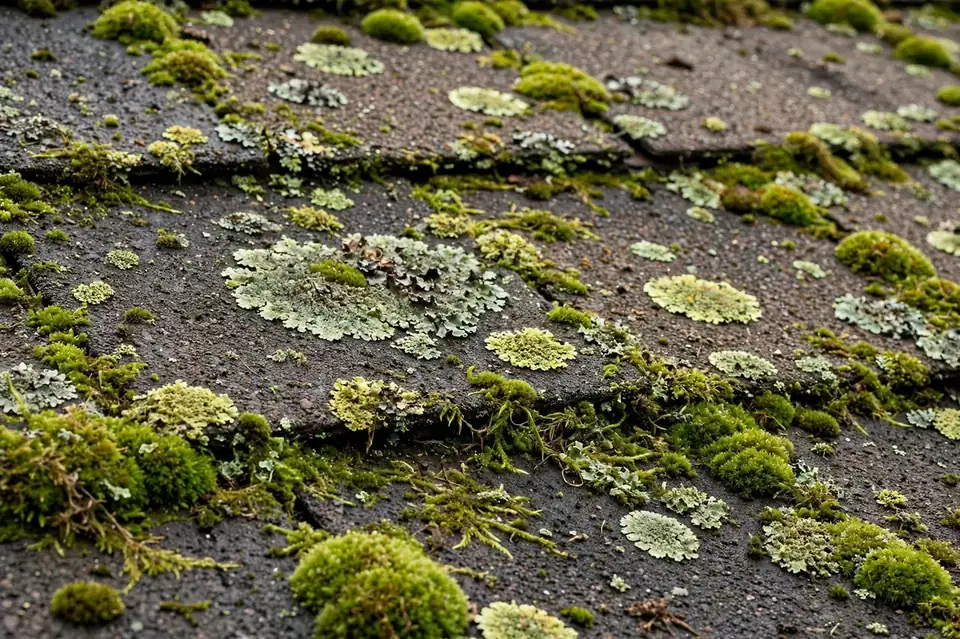
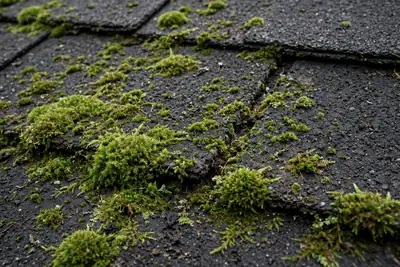
Moss growth can retain moisture on roofing materials and deserves careful assessment before cleaning. Professional soft-wash treatment kills moss, algae, and lichen at the root without pressure damage to your shingles.

Different growth needs different treatment. Here's what professional moss and algae service covers:
Thick green mats hand-lifted and soft-brushed off the roof, working down-slope with the shingle overlap — never against it. Patience here protects your granules.
Those dark streaks running down slopes are gloeocapsa magma feeding on shingle limestone. Roof-safe treatment kills it; the staining weathers off over weeks.
Crusty discs that bond tightly to granules — the hardest organism to remove. Treatment loosens the bond so growth releases without tearing the shingle surface.
Zinc or copper strips installed just below the ridge — rainwater carries metal ions down the slope, creating mild ongoing protection against regrowth.
Leaves and organic debris compost into perfect growing medium in shingle keyways. Clearing valleys, roof surfaces, and gutters removes the food source.
Where moss has already lifted edges or stripped granules, damaged shingles are replaced after treatment. Roof repair services →
Thick moss patches on shaded slopes. What it may indicate: established colonies with root-like rhizoids lifting shingle edges. Next step: the thicker the mat, the sooner it should be treated.
Black or dark-brown staining running with the water path. What it may indicate: algae feeding on the shingle's limestone filler. Next step: cosmetic at first, but it holds moisture — treat before it spreads.
Shingle tabs curling up where moss grows thick. What it may indicate: rhizoids breaking the adhesive seals. Next step: lifted edges admit wind-driven rain — don't wait on these.
Bare patches or heavy granules in gutters under mossy areas. What it may indicate: the protective layer is wearing through. Next step: granule loss is irreversible — treatment now preserves what's left.
Moss or plants taking hold in drainage paths. What it may indicate: chronic moisture and debris buildup. Next step: clear drainage first, then treat the roof.
Moss coming back to the same spots after cleaning. What it may indicate: the underlying conditions — shade, debris, drainage — were never addressed. Next step: treatment plus prevention, not just another cleaning.
Every method is chosen for what your roof is made of — the wrong approach does more harm than the moss:
Hand-lifting moss mats and soft-brushing, always working down-slope with the shingle overlap. The only mechanical method safe for asphalt shingles.
Solutions formulated for roofing materials that kill moss, algae, and lichen without harming shingles. Applied and left to work over weeks — dead growth weathers off naturally instead of being scraped.
Thin metal strips installed just below the ridge. Rainwater picks up metal ions as it flows over them, giving the whole slope below mild ongoing protection.
No pressure washing. High pressure strips protective granules off asphalt shingles along with the moss — trading a treatable problem for permanent roof damage. Any method involving a pressure washer on shingles is disqualifying.
Scope limits: treatment kills growth; it doesn't restore lost granules or reseal lifted shingles. Where moss has already done structural damage, repair follows treatment.
Not every property has every condition — but shaded, debris-prone slopes are common across Union City's housing stock.
Moss, algae, or lichen taking over your roof? Call to discuss gentle, roof-safe treatment options for your Union City home.
Call (201) 330-4743How a moss treatment job typically proceeds:
The roof is assessed for organism type — moss, algae, or lichen — and shingle condition. Landscaping below is noted for protection, and gutters are checked since treatment runoff has to go somewhere safe.
What's growing, how far it's spread, and whether shingles are damaged underneath. The scope covers treatment, any needed repairs, and prevention options.
Heavy growth is removed by hand, roof-safe treatment is applied, and prevention measures are installed. The estimate is agreed before work starts.
Treatment works over weeks, not hours. Dead growth weathers off naturally — and the follow-up confirms it's clearing and the prevention is holding.
Not all growth is equal. Knowing which you're looking at determines whether treatment alone is enough:
Where treatment reveals damage, repair follows — cleaning plus shingle replacement where the growth already did its worst. Union City roof repair services →
No invented prices — but these are the factors that set the real number:
Isolated patches versus full slopes colonized — area is the primary driver.
Surface moss treats faster; lichen bonds tightly and takes considerably more work.
Steeper pitches and tight-lot access add labor time, as with any roof work.
Cleaning alone versus cleaning plus shingle replacement where moss already damaged the roof.
Zinc strips, gutter clearing, and debris management add to the scope — and to the result.
A roof buried in leaves and branches needs clearing before treatment can even start.
An on-site assessment is the only honest way to price it — coverage and organism type can't be judged from the ground.
It's damaging. Moss anchors with root-like rhizoids that lift shingle edges and break their seals, and the mat holds moisture against the shingle surface continuously — accelerating granule loss. What starts cosmetic becomes structural.
Please don't. Pressure washing strips the protective granules off asphalt shingles along with the moss, shortening the roof's life significantly. Professional removal is manual — hand-lifting and soft-brushing — with roof-safe treatments doing the killing.
Moss forms spongy green mats that lift shingle edges. Algae (gloeocapsa magma) creates the dark streaks running down slopes and feeds on shingle limestone. Lichen forms crusty discs that bond tightly to granules and are the hardest to remove. Each gets a different treatment approach.
Light surface growth can wait for a scheduled treatment. But moss that's lifting shingle edges or sitting over bare granule patches is actively shortening roof life with every rain — the longer it stays, the more likely treatment alone won't be enough.
It can, if the conditions that grew it remain — shade, debris, poor drainage. That's why professional service includes prevention: zinc or copper strips, debris source management, and gutter clearing. Treatment without prevention is temporary.
Heavy moss is removed by hand immediately, but the treatment solution works over weeks — dead growth weathers off naturally rather than being scraped, which would damage granules. Full visual clearing typically takes several weeks.
Roof size and how much is colonized, whether it's moss, algae, or lichen, roof pitch and access, whether damaged shingles need replacing too, prevention add-ons, and debris load. An on-site assessment is the only honest way to price it.
Green mats, dark streaks, or lichen taking hold — call now to discuss gentle, roof-safe treatment for your Union City roof.
Call Now — (201) 330-474324/7 emergency roof repair calls answered; regular service appointments are scheduled.