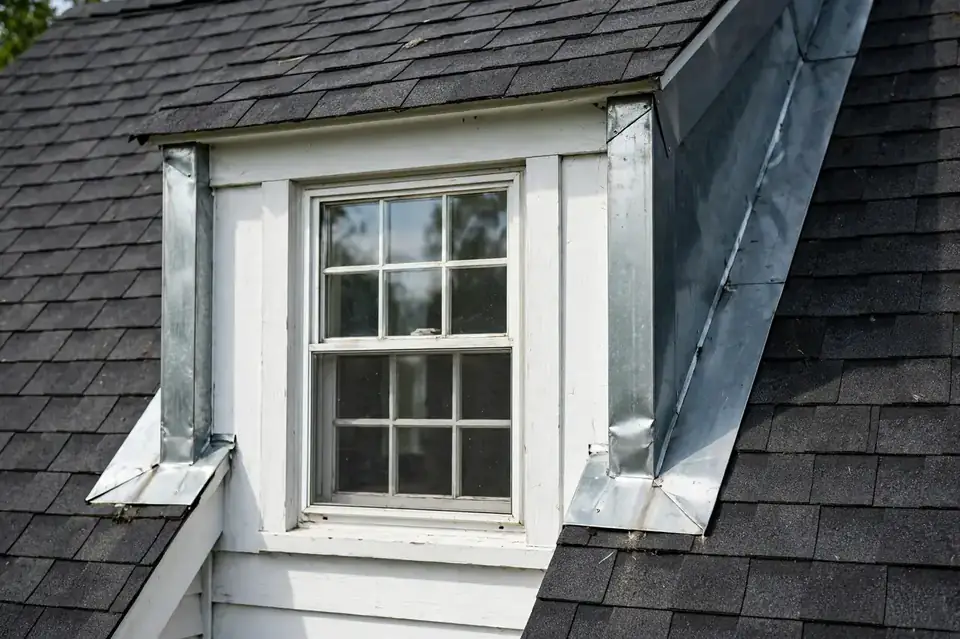
A dormer leak is a water-travel problem before it's a roofing problem. We trace the full path through Weehawken's west-side capes — then rebuild the flashing so it ends.
Emergency? We answer 24/7.

A dormer projects from the main roof slope to open up attic space — two side cheeks, a windowed front, its own small roof tied into the main slope. Every joint gets flashing: step flashing woven up both cheeks, apron flashing across the front, kick-out diverters where sidewalls meet the roofline.
What matters in Weehawken: all three details are metal, and metal is what waterfront air attacks. Salt-laden air accelerates corrosion — zinc coatings break down, aluminum pits, fasteners rust — so a flashing assembly that might last decades inland can fail years early near the Hudson. The failure pattern stays classic (water enters at the flashing, travels the wall cavity, stains rooms away from the breach), but the timeline compresses.

Salt-air corrosion gives dormer flashing a distinctive signature:
That last sign is the tell. A dormer sealed twice that still leaks was never a sealant problem — it's the metal, and it needs replacing.
The replacement metal's specification matters as much as the workmanship — ask what the roofer plans to use and why it suits a waterfront exposure.
Shingles and siding around cheeks and front are removed to expose the full flashing assembly — the only way to assess hidden metal.
Corroded step and apron flashing is replaced, woven course-by-course, with corrosion-resistant fasteners — the detail that sets the repair's lifespan.
Kick-out diverters installed or replaced at each sidewall base, so concentrated runoff leaves via the gutter.
Shingles and siding go back in correct lap order over the new metal; repaired transitions are water-tested.
Spot repair or full re-flash? If one cheek's metal is gone but the rest tests sound, localized replacement is honest work. But salt air doesn't attack one cheek and spare the other — if the apron is failing, the step flashing is usually on the same timeline. The metal's condition across the whole assembly, visible only once opened, decides.

Weehawken's defining factor is the Hudson: salt-laden air settles on every roof, accelerating corrosion on flashing metals and fasteners — the exact components a dormer depends on. Strongest on eastern exposures facing the water, present everywhere. The building mix shapes the work: mid-rises put dormers several stories up, where access and staging are part of the job's logistics, while west-side capes carry the classic dormer stock — older, often with original flashing from eras before kick-out diverters were standard.
We'll connect you with a local roofer who does dormer flashing work. Mention where staining appears, whether the dormer faces the river side, and whether the flashing has been "repaired" before — repeat sealant jobs are diagnostic information. Expect roof access to the dormer plus a look at the interior staining, since tracing the water path is half the job. Before authorizing, ask what metal and fasteners are specified, whether step, apron, and kick-out are all in scope, and how surrounding surfaces will be reintegrated.
Call (201) 330-4743 — 24/7. A roofer can weatherproof the dormer area to stop active intrusion, then schedule the full flashing replacement.
Salt air doesn't limit itself to dormers. The chimney flashing guide covers the roof's other metal-intensive detail — where waterfront corrosion usually shows first. The ridge cap guide explains what river wind does to the peak. And the Weehawken roof repair hub covers the full roof.
Salt-laden air settles on exposed metal, and each wet-dry cycle attacks protective coatings — galvanized steel loses its zinc layer, then the steel corrodes. Fasteners go first, then flashing edges. It's chemistry, not workmanship, which is why metal specification matters on waterfront jobs.
Sealant was never the problem — the metal underneath was. Sealant over corroded, pitted flashing buys time while water keeps finding the gaps. Two failed sealant jobs is the classic signal the flashing needs replacing, not resealing.
Aluminum is the common waterfront upgrade over galvanized steel, provided it's isolated from dissimilar metals. Copper is the long-life option. Either way, specify stainless steel fasteners — standard nails rust out in salt air and loosen the flashing.
Generally yes — eastern exposures take the most direct salt spray and wind-driven rain. But salt air reaches the whole town, so a sheltered dormer still ages faster than it would inland. The inspection should cover all the dormer's flashing, not just the river-facing cheek.
Properly installed flashing is almost entirely hidden — woven under shingles and behind siding, with only thin edges visible. What you'll see after reintegration is essentially what you saw before, minus the rust streaks. The difference is underneath.
← Back to Roof Repair in Weehawken · Dormer repair in North Bergen →