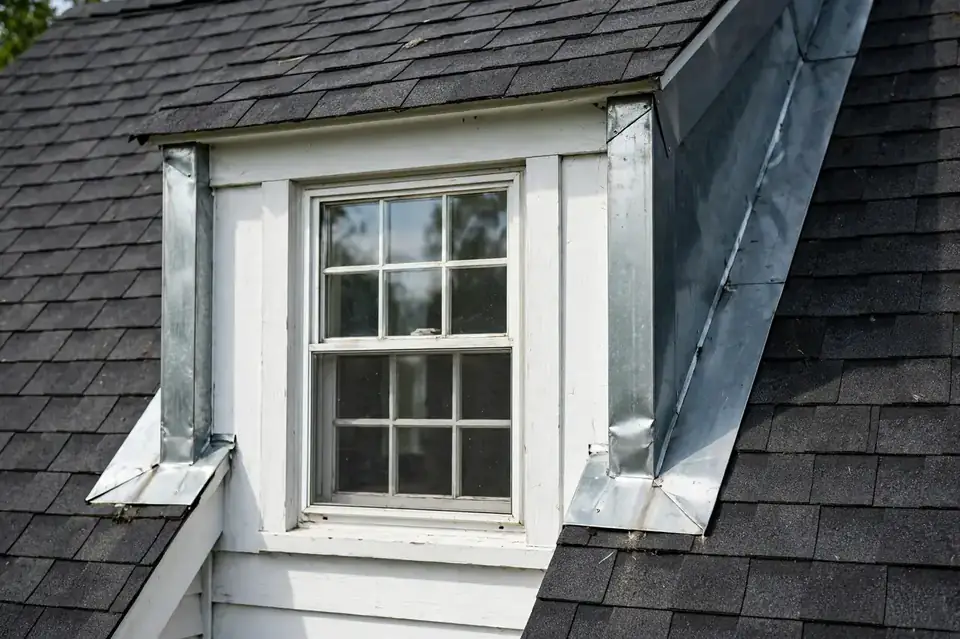
Most dormer "repairs" fail because nobody found the real entry point first. Our North Bergen roofers diagnose with a 20-minute inspection — then quote the actual fix.
Emergency? We answer 24/7.

A dormer is the projected structure that rises from a sloped roof to bring light and headroom into a top floor — the little house-within-a-house on capes, colonials, and converted attics across North Bergen. Every joint where it meets the main roof needs flashing: step flashing woven up both cheeks, apron flashing across the front, and kick-out diverters where sidewalls meet the roofline, throwing runoff into the gutter.
When any of these fail, water doesn't drip below the breach — it enters the wall cavity and travels inside the structure, surfacing as a stain rooms away from the entry point. That's why dormer leaks are famously misdiagnosed: the stain marks where water exits, not where it enters.

A stain confirms water is getting in — not where. The failed component has to be found by inspection, never assumed from the stain's location.
Scope follows findings. A roofer who quotes a dormer repair without opening the transition and tracing the water path is guessing.
Shingles and siding around the cheek and front are removed to expose the full flashing assembly — the only way to see what's actually failed.
Damaged step and apron flashing comes out; new flashing is woven course-by-course, with kick-out diverters installed or corrected at the sidewall base.
Shingles and siding go back over the new metal in correct lap order, so water sheds across every joint instead of behind it.
The repair is water-tested and surrounding details checked — the dormer leaking today often has a sibling flashing detail ready to fail next.
Repair or rebuild? Most dormer problems are flashing problems, and flashing is repairable. But if the inspection reveals rotted framing from years of hidden leakage, the scope may widen to re-flashing the full perimeter or rebuilding the weather envelope. The honest answer depends on what's found when the transition is opened — treat any firm quote before that as provisional.

North Bergen's hilltop properties sit more exposed than the blocks below, and exposed elevations take wind-driven rain straight into dormer cheeks — the joint most vulnerable to sideways water. The town's mixed housing stock adds a second factor: dormers here span many construction vintages, and flashing standards (and shortcuts) vary widely across them. A dormer from a 1990s conversion may have detailing a 1960s original never got, or vice versa. The inspection matters more than the assumption.
We'll connect you with a local roofer who handles dormer work. Mention where the stain appears, whether it shows in all rain or only wind-driven storms, and the roof's approximate age if you know it. Expect the roofer to examine both the exterior dormer and the interior evidence — tracing the water's path is half the diagnosis. Before authorizing, ask which flashing pieces are being replaced, whether a kick-out diverter is included, and how shingles and siding will be reintegrated.
A stain won't fix itself. Call (201) 330-4743 — 24/7. A roofer can tarp the dormer area to stop active intrusion, then schedule the proper flashing repair.
Dormer leaks rarely travel alone. Check the chimney flashing too — the other most common leak source on North Bergen's older roofs, often the same vintage. The ridge cap guide covers what wind does to the peak on exposed hilltop properties. And the North Bergen roof repair hub lays out the full picture.
Water enters at the failed flashing, then travels inside the wall cavity until gravity pulls it out somewhere visible. The stain marks the exit, not the entry. Finding the breach requires inspecting the dormer's flashing transitions — not the stained ceiling.
Sealant can buy time on a minor gap, but a proper repair requires opening the transition — removing surrounding shingles and siding to replace the failed metal underneath. Sealant over failed flashing is a temporary patch, not a repair.
A small angled flashing piece where the dormer sidewall meets the roof, throwing runoff into the gutter instead of down the wall. Many older dormers never got one. Any competent re-flash should include one.
It's sensible. Chimney and dormer flashing are often the same age and fail on similar timelines, and a roofer already set up for flashing work can assess both in one visit rather than two.
The flashing itself is hidden once reintegrated, so matching matters most for disturbed shingles or siding. Ask how the roofer handles material matching before authorizing — exact matches are harder to source on older roofs.
Free inspection-first estimates in North Bergen.
Call (201) 330-4743← Back to Roof Repair in North Bergen · Dormer repair in Weehawken →