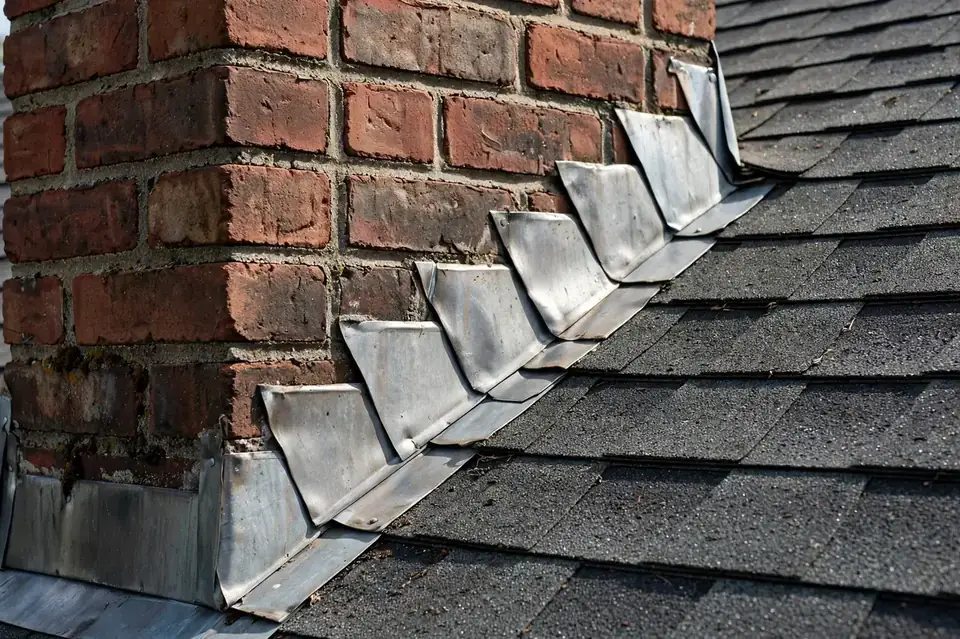
Union City's rowhouses share chimneys on party walls — one chimney, two owners, one flashing system. When it fails, both sides get wet. We rebuild it for the whole chimney.
Emergency? We answer 24/7.

Flashing is the metal transition that seals the joint where your chimney passes through the roof — the one place on the roof where two completely different materials, moving at different rates, have to stay watertight together. Brick expands and contracts with temperature. The roof deck flexes under wind and foot traffic. The flashing bridging them absorbs all of that differential movement, year after year, while sitting in the most weather-beaten square feet on the roof.
A proper chimney flashing job is actually four components working together. Step flashing — small L-shaped metal pieces woven into the shingle courses up both sides of the chimney. Counter flashing — metal set into the chimney's mortar joints, folded down over the step flashing to shed water onto it. Apron flashing across the downhill face. And on wide chimneys, a cricket — a small peaked diverter on the uphill side that splits water around the chimney instead of letting it pond against the masonry. When any one of these fails, water gets behind the system and into the house.
The root cause is movement. Brick and wood framing expand and contract at different rates through every freeze-thaw cycle, and the flashing caught between them flexes thousands of times over its life. Eventually sealant cracks, mortar joints holding the counter flashing loosen, and step flashing works free of the shingle courses.
Chimney flashing can't be assessed from the driveway. When we connect you with a local roofer, the inspection typically covers:
The inspection distinguishes a flashing problem from a masonry problem — they leak identically from inside the house, but the fixes are completely different.
Old step and counter flashing come out, along with the surrounding shingle courses that have to be lifted to access them. This is the labor-intensive part — there's no shortcut that lasts.
Soft mortar joints get repointed so the new counter flashing has something solid to seat into. If the crown is cracked, that's repaired too — new flashing on bad masonry is money wasted.
New step flashing is woven into fresh shingle courses up both sides; new counter flashing is set into the repointed mortar joints and folded over the step flashing. A cricket goes on wide chimneys that lack one.
Seams are sealed, the surrounding shingles are re-laid, and the whole assembly is water-tested where possible. The roofer shows you the finished work before leaving the roof.

Tell the roofer where you're seeing water: ceiling stains near the chimney, damp smells, or visible gaps in the flashing. Note whether it leaks in every rain or only wind-driven ones — that distinction helps diagnose whether it's the step flashing, the counter flashing, or the crown. A local roofer will inspect the full chimney assembly, distinguish flashing failure from masonry failure, and lay out the scope before any work starts.
Call (201) 330-4743 — 24/7. A roofer can apply emergency weatherproofing to stop the water now and schedule the permanent flashing repair after.
Chimney leaks are routinely misdiagnosed, so it's worth checking the neighbors. Ridge cap damage above the chimney lets water in at the peak that tracks down to the chimney chase — if your caps are suspect, read the ridge cap repair guide first. Skylights near chimneys fail in similar ways and leak identically from inside; the skylight repair guide covers how to tell them apart. For the full picture, the Union City roof repair hub maps every service to its symptoms.
From inside the house they look identical, which is why the inspection matters. A roofer checks whether the step and counter flashing are intact and seated in sound mortar. If the flashing is good but the crown is cracked or the brick is saturated, the masonry is the source — and flashing work won't fix it.
It can often be repaired. If the metal is sound and only the sealant has failed, a proper reseal is legitimate. Full replacement — a reflash — is needed when step flashing is corroded or displaced, counter flashing has pulled out of failed mortar, or the original installation was wrong.
A cricket is a small peaked diverter framed on the uphill side of a chimney. It splits water and debris flow around the chimney instead of letting them dam against the masonry. Wide chimneys without one are chronic leakers — a roofer will tell you if yours qualifies.
Wind drives water sideways into joints that vertical rain never reaches — typically gaps in step flashing or failed sealant on the windward side. Leaks that only appear in storms point to the flashing system rather than the masonry.
The flashing seals the joint for the whole chimney, so the repair benefits both sides. Talk to your neighbor before work starts — a roofer can explain what's being fixed and why, which usually settles the question quickly.
Chimney width, masonry condition (sound mortar versus repointing needed), roof pitch and access, how many shingle courses must be disturbed, hidden sheathing damage, and material choice. A roofer needs to see the chimney to quote honestly.
A reseal can be done in a few hours. A full reflash with repointing is typically a full day's work, since it involves removing old flashing, addressing the masonry, installing new step and counter flashing, and re-laying the surrounding shingles.
documentation both owners can use.
Call (201) 330-4743← Back to Roof Repair in Union City · Chimney flashing in Secaucus →