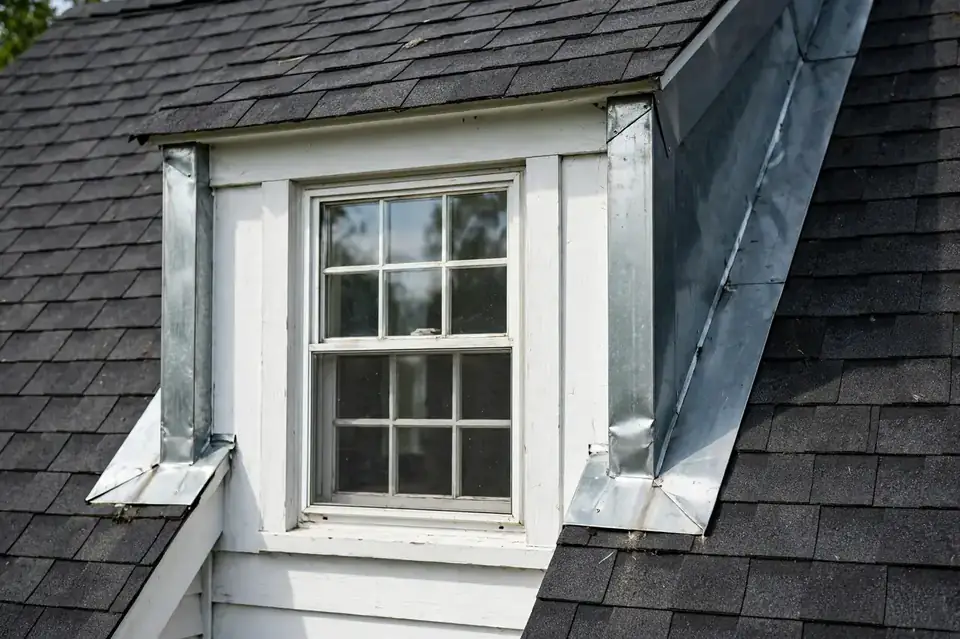
West New York's pre-war walkups carry dormers flashed a century ago — and a century is exactly how long that flashing lasted. We rebuild them to modern standards.
Emergency? We answer 24/7.

A dormer is a small structure built onto a roof — walls, its own roof, windows — packing more transitions into a few square feet than the rest of the slope combined. Every wall-to-roof joint is a seam that must shed water, and those seams depend on metal flashing, not shingles: shingles shed water downhill, but flashing makes water turn corners.
Visible symptoms suggest where to look, not what's wrong — a stain under a dormer can also be a failed window seal, which is why the inspection traces water to its entry point.
Dormer flashing fails for a short list of compounding reasons. Out-of-sequence step flashing is the most common: flip the overlap order anywhere along the cheek and water runs behind the metal. Sealant used as structure is the runner-up — caulk as the primary defense hardens and cracks within a few seasons, leaving nothing behind it.

When we connect you with a local roofer, the assessment is a trace, not a guess — water entry is confirmed at the source before any scope is written:
The scope follows the findings: a single displaced apron is a different job than systemic failure across three dormers.
The roofer confirms the entry point — cheek, apron, or kick-out — and photographs the failed transition before anything is disturbed.
Siding and shingles are pulled back along the dormer to expose the full flashing run. Partial exposure is how leaks get missed.
Step flashing is replaced up both cheeks in correct overlap order, the apron rebuilt across the front, kick-out diverters installed at the gutter line.
Siding is reinstalled lapping over the new metal, shingles woven back in, and the repair water-tested where practical.
Most dormer leaks end at the flashing: rebuild the step, apron, and kick-out sequence correctly and the problem is solved. The line moves when the leak has run long enough to rot sheathing and framing — then substrate replacement joins the scope, and the roofer should show you the damage and explain the added work before proceeding. Same when every dormer shares one failed flashing vintage: fixing one while the others wait is short-term thinking a good assessment will flag.
Don't research — call. (201) 330-4743, 24/7. A dormer leak can travel far inside the wall before it shows; stopping the entry sooner limits the hidden damage.
West New York sits elevated on the Palisades, and elevation means wind. Wind-driven rain hits dormer cheeks and aprons harder here than on sheltered streets, accelerating lifted aprons, loosened step flashing, and beaten-out sealant. The town's dense pre-war stock adds the second factor: many dormers carry decades-old flashing, installed to older standards, sometimes without kick-out diverters at all.
Describe what you're seeing — stain location, whether it's active in rain, roof age. You get a written scope of which transitions failed and what the fix includes. Before authorizing, clarify: does the quote cover siding removal and reinstallation, what happens if rot is found, and were sibling dormers checked?
Dormer flashing shares its DNA with chimney flashing repair in West New York — both are step-flashing systems one visit can cover. If the entry point is still uncertain, the West New York roof repair hub covers full diagnostics, and ridge cap repair is worth checking after any wind event.
Water enters at the failed flashing and travels inside the wall cavity, following gravity and framing until it finds an exit — often a room or two away. The repair targets the entry point, not the stain.
Sealant alone fails within a few seasons — it hardens, cracks, and there's nothing behind it. Durable dormer repair rebuilds the lapped metal flashing sequence; sealant is only the backup gasket.
It's a small angled flashing piece where the dormer sidewall meets the gutter line, throwing wall runoff into the gutter. Without it, water pours behind the siding and rots sheathing out of sight. If yours is missing, it should be added during the repair.
Along the dormer transition, yes — the flashing sits behind the siding, so there's no way to rebuild it properly without pulling siding back. It gets reinstalled lapping correctly over the new metal.
Yes, when they share one flashing vintage. The leaking dormer is usually just the first to fail; checking the siblings during the same visit costs little and prevents the next leak.
A single dormer re-flash is typically a day's work once opened. If rot is found behind the flashing and substrate needs replacement, the scope — and the timeline — grows with it.
roofers who know West New York's pre-war buildings.
Call (201) 330-4743