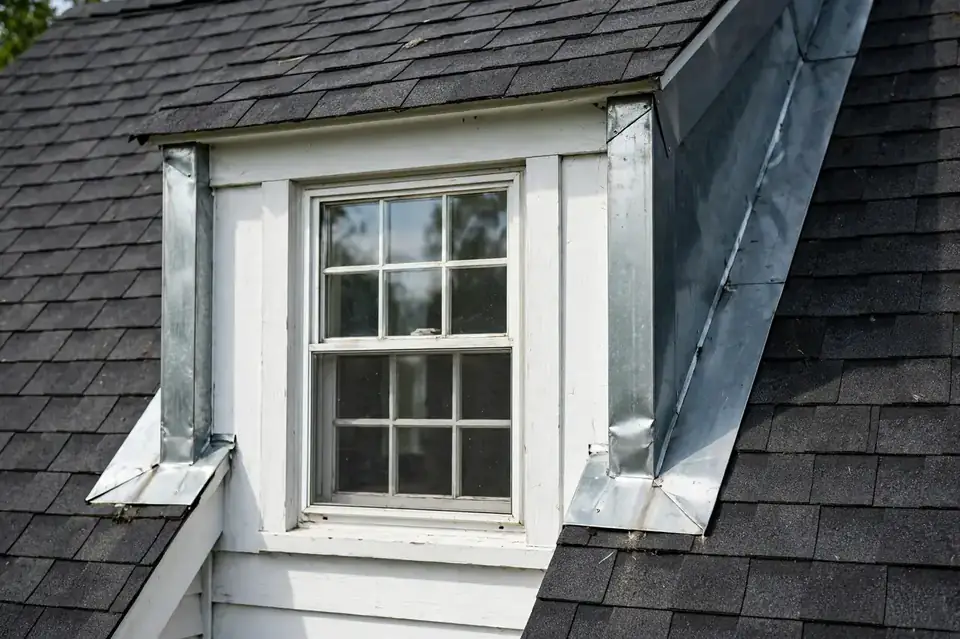
Dormer leaks in Secaucus garden communities raise one question before any other: whose roof is it? We fix the flashing and handle the HOA paperwork trail.
Emergency? We answer 24/7.

A dormer is a structure that projects from a sloped roof — typically with its own small roof, two side walls called cheeks, and a front face. Every place the dormer meets the main roof is a joint, and every joint is flashed: step flashing runs up both cheeks, woven with the shingles; apron flashing spans the front where the dormer roof meets the wall above it. Done right, water sheds from dormer roof to flashing to main roof to gutter. Done wrong — or twenty years on — it gets behind the flashing and into the wall cavity.
What makes dormer leaks uniquely frustrating: water inside a wall cavity obeys gravity, not floor plans. It enters at a failed cheek joint, travels down inside the wall, and surfaces wherever it finds an exit — sometimes rooms away, sometimes a floor below. The stain marks the exit; the durable fix starts by finding the actual entry point.
The most common dormer defect is invisible from the ground: missing kick-out diverters. Where the sidewall meets the roof at the gutter line, this small angled metal piece should throw water outward into the gutter. Without it, runoff dumps straight behind the siding — a tiny omission that causes enormous hidden rot.
Step flashing ages out — metal corrodes, sealant lines fail after decades of thermal cycling. Siding installed tight to the roof wicks water upward and traps it. Clogged gutters back water into the cheek joint. House settling cracks rigid seals where dormer meets main roof. Dormers flashed together tend to fail together — the one leaking today is usually just the first.
Siding and shingles at the dormer base are removed to expose the full flashing assembly — the repair starts from what the metal shows, not from where the stain appeared.
Step flashing is replaced up both cheeks, woven with the shingles; the front apron flashing is rebuilt across the dormer face.
Kick-out diverters go in where sidewalls meet the gutter line, and siding is reinstalled with proper clearance above the roof surface.
On buildings with multiple dormers of the same vintage, the others get inspected too — matching flashing usually means matching failure timelines.
A localized flashing rebuild solves it when damage is confined to the metal and adjacent materials. But water entering for seasons may have rotted sheathing behind the cheeks or the siding itself — then the scope honestly grows to include sheathing or re-siding work. A roofer should open the joint and show you what's there before finalizing scope; anyone quoting a fixed price without exposing the transition is guessing.

Step flashing is a series of small L-shaped metal pieces, one per shingle course, climbing the cheek — each overlapping the one below so water always moves outward and down. Apron flashing spans the dormer's front, bridging from dormer roof up under the wall above. The kick-out diverter is the small angled flashing at the sidewall base that kicks runoff into the gutter — a tiny part that prevents major rot.
Siding clearance — the gap between siding bottom and roof surface, typically an inch or two — keeps siding out of standing water. It's part of the repair, not a cosmetic detail.
Most Secaucus dormers sit on HOA-run garden-apartment and townhome buildings, where leaks trigger the classic who-pays question first: in most local CC&Rs the association owns everything outside the drywall — dormer flashing, cheeks, siding — while the unit owner owns the stained interior. Document the stain and raise it with the property manager before authorizing work. Scheduling also typically runs through the manager to fit quiet hours and access rules.
Water inside a wall cavity doesn't wait. Call (201) 330-4743 — we connect Secaucus homeowners with local roofers, 24/7 for emergencies.
When you call, describe which unit shows the stain and where the nearest dormer sits — they may be unrelated, and knowing both helps plan the inspection. Photos of the stain and the dormer exterior help. Expect the inspection to cover inside (tracing moisture, checking insulation) and outside (the full transition) — the entry point is found by investigation, not assumption.
In an HOA building, have your CC&Rs or manager contact handy — findings usually need documenting in plain language and photos for board review, with exterior flashing work separated from interior restoration. Rebuilds typically finish in a single visit once scoped; hidden rot found during the work is what extends a job.
Dormer work pairs with chimney flashing repair in Secaucus — same step-flashing craft, one mobilization instead of two. If the leak has been active a while, a full Secaucus roof assessment checks surrounding decking. On tile roofs, dormer transitions need tile-specific flashing, so those scopes belong in one conversation.
Water entering at a failed dormer flashing joint travels inside the wall cavity, following gravity and framing — not the floor plan. It surfaces wherever it finds an exit, which can be a room or two away or a floor below. The stain marks the exit; the dormer transition is the entry. That's why tracing the path matters more than patching above the stain.
In most Secaucus garden-apartment and townhome CC&Rs, the association owns the exterior — including dormer flashing, cheeks, and siding — while the unit owner owns the interior finishes. Check your documents and raise the issue with the property manager before authorizing work; the repair bill may belong to the association.
A small angled flashing where the dormer's sidewall meets the roof at the gutter line. It kicks runoff outward into the gutter instead of behind the siding. Missing kick-outs are among the most common and most destructive dormer defects.
Not properly. The step flashing sits behind the siding at the cheek, so reaching it means opening that transition. Anyone offering to fix dormer flashing without removing siding is proposing a surface patch, not a repair.
All of them, at least visually. Dormers flashed at the same time with the same materials tend to fail on the same schedule — the one leaking today is usually just the first. Checking siblings during the same visit is far cheaper than a second emergency call.
Secaucus homeowners, HOAs, and property managers.
Call (201) 330-4743← Back to Roof Repair in Secaucus · Dormer repair in North Bergen →